
The Back Door
On arriving late, learning sideways, and why that doesn’t make you a monster.

Maybe 2016 was more than reggaeton and cut crease. I was there for all of it, the YouTube beauty boom, the highlight to the gods, the carved brow, the triangles of concealer under the eye and the Kim Kardashian Kontouring. Bad Bunny was just arriving. I was about to take my first long haul flight to Mexico. Life was bold, bright and beauty full.
And then Brexit happened.
I was there for that too, in a very specific way. I volunteered on the day. I was a helper elf in the backstage ballot machinery. I handed things to people. I kept things moving. I wore nothing political, said nothing political, and I did not and could not insert a slip into a ballot box.
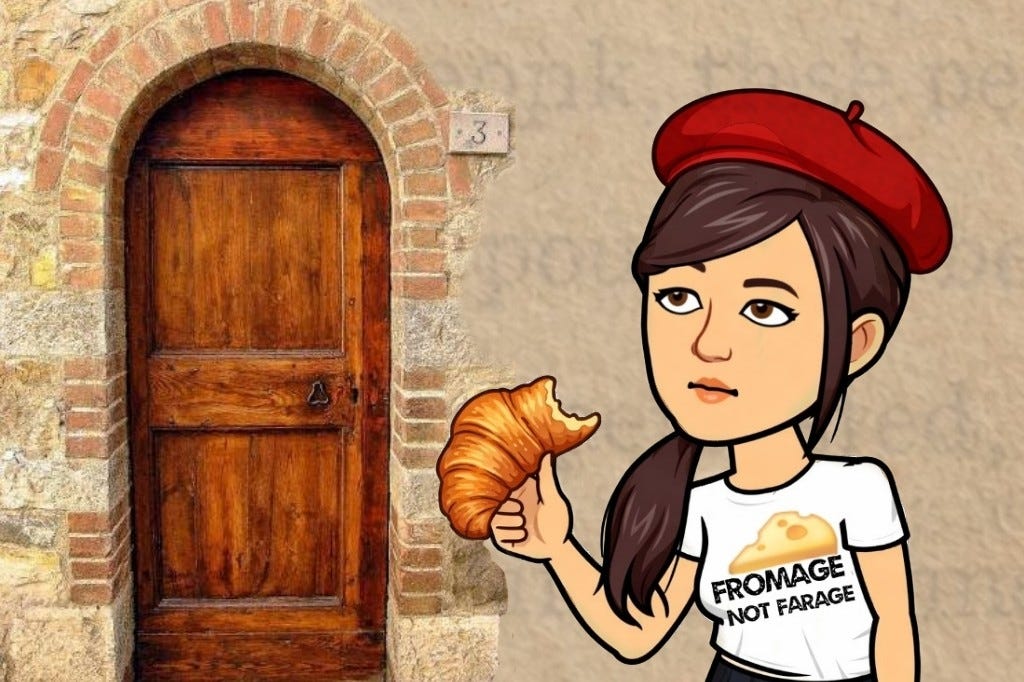
Because I am French.
I have lived in the UK long enough to have earned the right to moan about the weather all day long. I moved here because I had been given something extraordinary at birth: a permission slip. Free movement. The unshakeable confidence of knowing that the borders of Europe were mine to cross whenever I was ready. I grew up knowing I would make the most of it. I didn’t feel like an immigrant. I felt like someone exercising a birthright.
And then, in a single night, in a result I was not allowed to vote on, that permission slip was revoked.
I have thought a lot about what it means to be politically disengaged. I have been accused of it. Not long ago, someone told me that choosing not to follow politics closely was embarrassing. That it was a privilege. That I should be ashamed. She wasn’t entirely wrong about privilege. She was entirely wrong about me.
I didn’t disengage from politics. Politics disengaged from me. And when it did, I made a decision: if I couldn’t vote in the elections that shaped my life, I wasn’t going to vote in the ones I was technically allowed to participate in either. I have been chased about registering ever since. There’s apparently a fine. I haven’t seen it in ten years. I remain unregistered. I remain French.
This is not apathy. This is a principled, sustained and slightly chaotic act of protest.
But here is the thing I didn’t say clearly enough, the thing I’ve been circling around: I was never not paying attention. I just came to it sideways. Through people I trusted, writers, thinkers, humans I had followed for their takes on lipstick who turned out to also have takes on the world. Little by little, their words opened a door. I didn’t always understand what was on the other side. But I started listening.
And when the overwhelm became too much - and it did, regularly, the feeling of arriving at episode 254 of a series you’ve never seen - I found another classroom. A quiet one, without anyone waiting to make me feel small for not already knowing. I asked questions I was too embarrassed to ask out loud. I filled in gaps. I learnt, at my own pace, in my own time, with no one grading me on arrival.
I am not going to pretend I know everything about politics. Not even close. My gaps are massive and I’ve made the mistake of advertising them in ways that invited correction rather than conversation. But here is what I do know: I look up to Corbyn. And Sultana. And Ardern. Not because I can cite their policy positions chapter and verse, but because they govern the way I try to write: with the person on the receiving end always in mind. They “consider the reader”. That is my politics. It has always been my politics. I just didn’t have the language for it.
I said something similar once about Bad Bunny. You don’t need to know all the lyrics to enjoy the song. You don’t need to have heard the full album to give yourself permission to go to the concert. You don’t need to understand the offside rule to feel something when the ball hits the net.
The feeling arrives before the vocabulary does. It always has. That is not a less valid form of engagement. That is where engagement actually begins.
Politics is no different. You are allowed to feel that something is wrong before you can name the policy that caused it. You are allowed to be outraged before you can cite the clause. The people who tell you otherwise are not more politically engaged than you. They are just more comfortable with the jargon. And jargon, it turns out, is a very effective door.
I also know this: the stance you hold on abortion is politics. The way your workplace treats you is politics. The reason your rent is unaffordable is politics. The fact that some people get to call themselves expats while others are called immigrants - and you know exactly which ones are which - is politics. You were already inside it. You just didn’t recognise yourself in the word.
And if nobody has told you this recently: you are not required to know everything before you’re allowed an opinion. You are not required to have watched all 254 episodes before you’re allowed to feel something about the finale. The people who make you feel that way are not gatekeepers of democracy. They are just loud. I know, because one of them once told me that my overwhelm was a choice I should be ashamed of.
To her, and to everyone like her, I want to say this gently: the way you talk about politics to people who are still finding their way in does not make them more engaged. It makes them feel that the door is not for them. And then you turn around and ask why nobody is walking through it. Congratulations! You just pushed someone further away. Is that what you really wanted to achieve?
The door is still open, by the way. It was always open. It’s just that not everyone was told that and some of us had to find the back entrance. You are more politically aware than you think you are. And you are worthy of being known, exactly as you are. Gaps, blind spots, late arrivals and all. ♥
A note of genuine gratitude to Glen Fielding, whose comment on a previous piece gave me a framework I didn’t know I needed. He introduced me to the idea, rooted in political science, that universal, intense political engagement might itself be a sign of democratic ill-health. That not everything needs to be at the centre of life. That there is a difference between apathy and exhaustion, between disengagement and disenfranchisement. I had been living that distinction for years without the words for it. This essay exists because he handed them to me.
Further reading: How YouTube Invented Viral Beauty by Farrah Gray (Beauty Hotline)
Snapping my fingers to every line here. Besides all the other intelligent stuff to unpack in this piece, I love the sucker punch that politics isn’t some sort of country club that’s members only. It’s available to everyone all the time. People are allowed to dip in and dip out and choose what to throw their energy into and when to save their energy for next time.
This is very interesting. I lived in London in like 2002, I landed with an Italian passport. No problems. That world got shitty. This is the most political thing I have ever read. That’s not a bad thing.