
The Hope Trap
On unguarded moments, delayed clarity, and the small vulnerability that lands across millions

Two months ago, a lazy slideshow of mine did a hundred thousand views on TikTok. The guard came down just enough to think: maybe I could make more of these. Within days, my For You Page was wall-to-wall TikTok Growth Gurus. TTGGs, I started calling them. Post to stories. Use new features. Hook in the first three seconds. Consistency is king. I watched. I took notes. I tried things.
And then I noticed something. The TTGG’s content is the growth hack. Their entire niche is telling you how to get big on TikTok and by watching them, you make them big on TikTok. It’s a closed loop. You watching them is the thing they’re teaching you to do. I dismantled the advice. I wrote a piece about it that I never published, because I didn’t have a platform yet, and by the time I had one, I understood that the piece was pointing at the symptom rather than the thing underneath. The symptom was the TTGGs. The thing underneath is older and has nothing to do with TikTok. It’s hope. And what happens to it when it meets the right opportunity at the wrong moment.
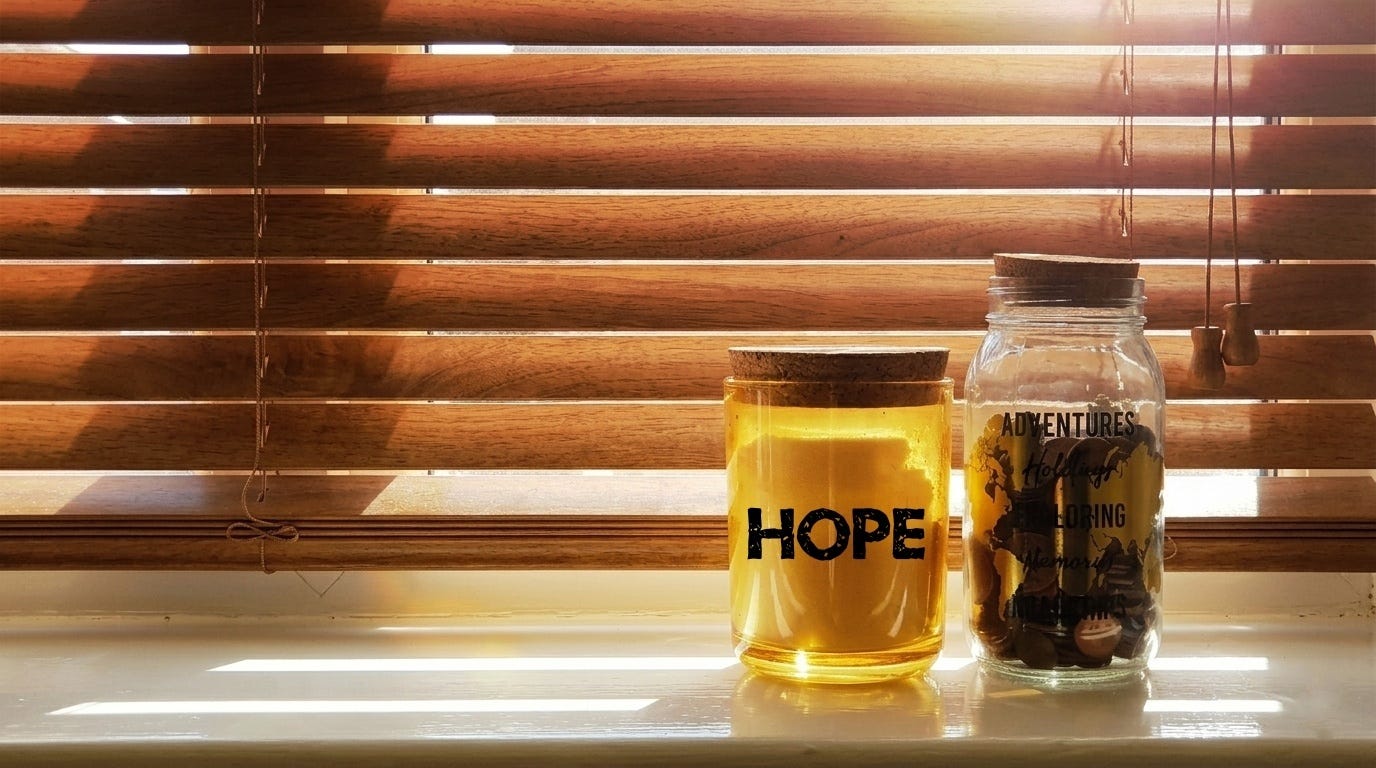
Hope is almost universally described as a virtue. The thing that saves us. That separates the resilient from the defeated. That keeps us going when the evidence suggests we should probably stop. And that’s partly true. I’m not here to argue against hope entirely. I would like to keep some, in a small jar, for emergencies.
But hope has a dark side that nobody wants to acknowledge. Hope is also a door left ajar. And the door doesn’t open because we are foolish or particularly susceptible. It opens because the unguarded moment is not a weakness of character. It is part and parcel of being human. It arrives for everyone, without exception, at different times.
One video that does unexpectedly well. One Substack note that lands when you didn’t think it would. One morning when the guard drops just enough to think: maybe this time. That’s all it takes. The moment is small. That’s exactly what makes it land across millions of people at once. Not a grand delusion shared by the naive. A tiny one, shared by everyone, briefly, when something cracks open just enough to let the light - or the pitch - in.
The growth gurus and every person who has ever sold a recipe to a place they’ve never taken anyone will always find a way to thrive. Not because they are particularly brilliant. Because hope is not strong. It’s small and specific and arrives exactly when we are most open and least defended. And some people have learnt to be standing there when it does. Here is what makes the pitch so effective. It doesn’t just sell hope. It sells hindsight.
Come with me and I will show you what I know now that I didn’t know then. Here is the shortcut I took the long way to find. Here is the recipe I wish I’d had. If I had to do it all over, this is precisely how I would do it. You don’t have to make my mistakes. You just have to follow the playbook.
And we fall for it. Not because we are foolish, but because hindsight is genuinely valuable, and the offer of it, packaged neatly with a hook in the first three seconds feels like exactly what we needed in that unguarded moment. The problem is that someone else’s hindsight was never really yours to follow. You can have the recipe. You still have to cook.
I would like to invite you to do something uncomfortable. I would like you to think of your own unguarded moment. Not the TTGG specifically, though if that’s yours, welcome, there are many of us. I mean the broader version. The moment when the guard came down just enough. When you let yourself believe. When the door opened and something walked in before you’d decided whether to let it.
Mine are embarrassingly recognisable in retrospect. The moving in. Love will solve it, I thought. No conversation required about the mental load, or who pays what, or what happens if it doesn’t work out. Love was the answer, and I had it, and that was enough. The guard was down. The door was open. The bill came later, on its own schedule, with interest.
The 11pm task. It will only take an hour, I estimated. With brazen confidence. The all-nighter that followed was not a surprise to anyone who knows me, which at the time did not include me.
The wrong first date. All the red flags visible from the surface of the moon. A trusted friend, just as deluded, bless her, saying: Go on, you’d never know, what if? And you have no answer to what if. You never do. That’s the whole mechanics of it. What if is hope’s most effective delivery mechanism. It arrives as a question so it cannot be argued with. It just sits there, open-ended, while the guard thinks about it.
The doom and gloom was always coming. Hope just rescheduled it. And sometimes charged you for the delay.
Here is what I would like to say before I close, because I don’t want to leave you with the impression that hope is the villain. It isn’t. The unguarded moment isn’t a failure of judgement. It’s proof that you are still in there, still capable of believing, still open enough to be reached, still human enough to think maybe this time even after the last time didn’t work out. The more we fall, the sharper the intuition gets. Not immediately. Not without cost. But eventually.
And perhaps that is the real function of hope, not to protect us from the bill, but to make sure we keep moving towards it. Every unguarded moment, even the ones that cost us, teaches us something about where the door is and what tends to walk through it.
We get better at recognising the pitch. We get better at staying in our own clarity rather than buying someone else’s. We get better, little by little, at deciding when to leave the door ajar and when to keep it closed.
You might have noticed I’ve been up to something. I bit the bullet. I opened a second publication not because émoi needed a companion, but because it needed protecting. The mechanics of this platform, the frustrations, the politics of trying to get your work read: They kept leaking into this space and I didn’t want that. Émoi is not the place for that conversation. So I built one that is. It’s called Back Kitchen. No front of house there. I could have imported your names but I didn’t, because that felt wrong. This is your opt-in, if you want it. [Come through the back →]
What you said about the gurus selling you growth is so true. I wrote about it in a different way on my page : Hear All, Heed Some. Beautiful piece by the way.
Your concept of selling hindsight is a sharp reminder that someone else’s playbook can never replace our own lived clarity. It’s a beautifully written, necessary reality check that reframes our unguarded moments not as foolish failures, but as the inevitable, expensive tax we pay for staying human, open, and capable of belief. It’s the kind of writing that doesn’t just make me nod along; it makes me look at my own open doors.