

The Wrong Relationship
On school, the best years of your life, and the blank page that was never your fault.

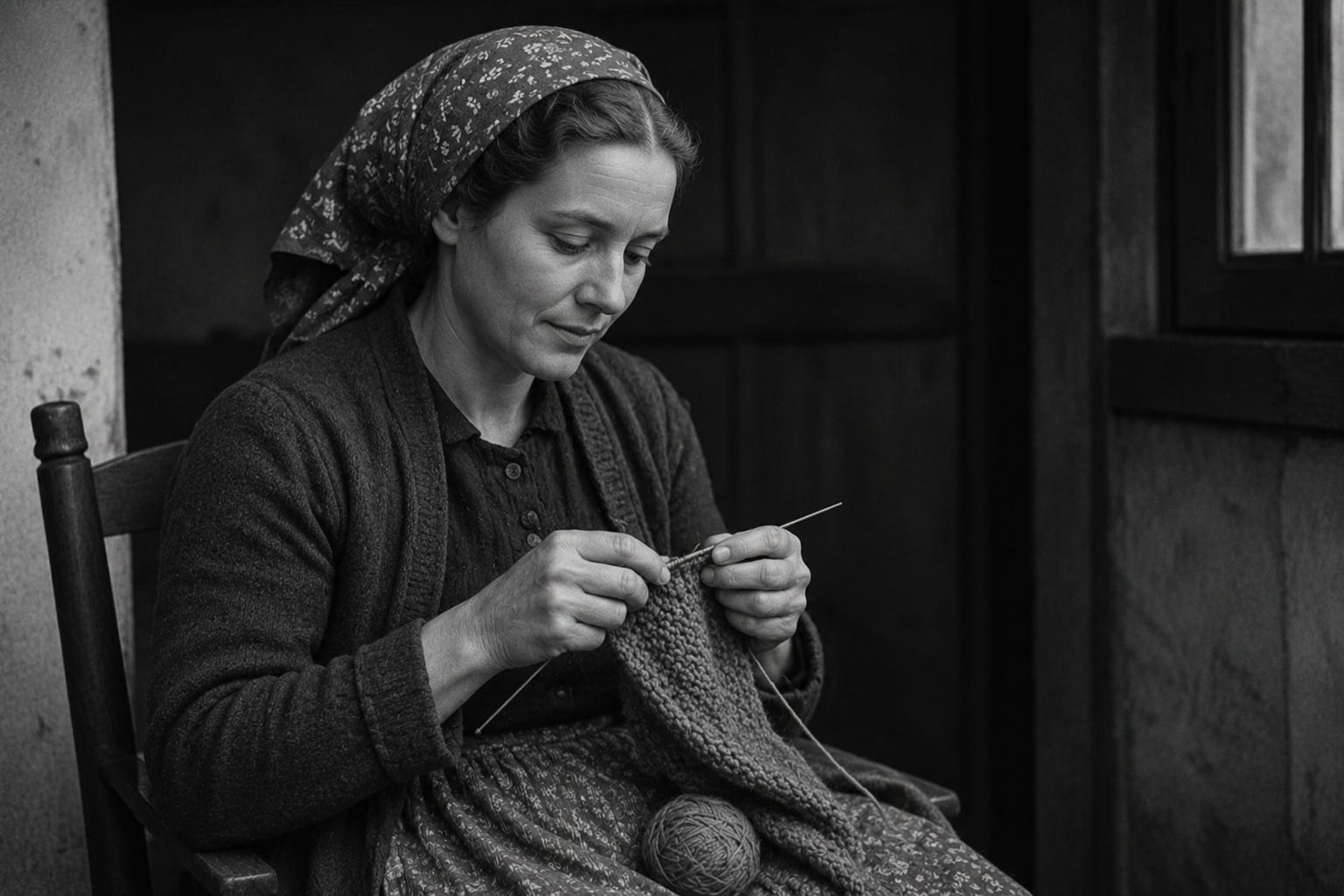
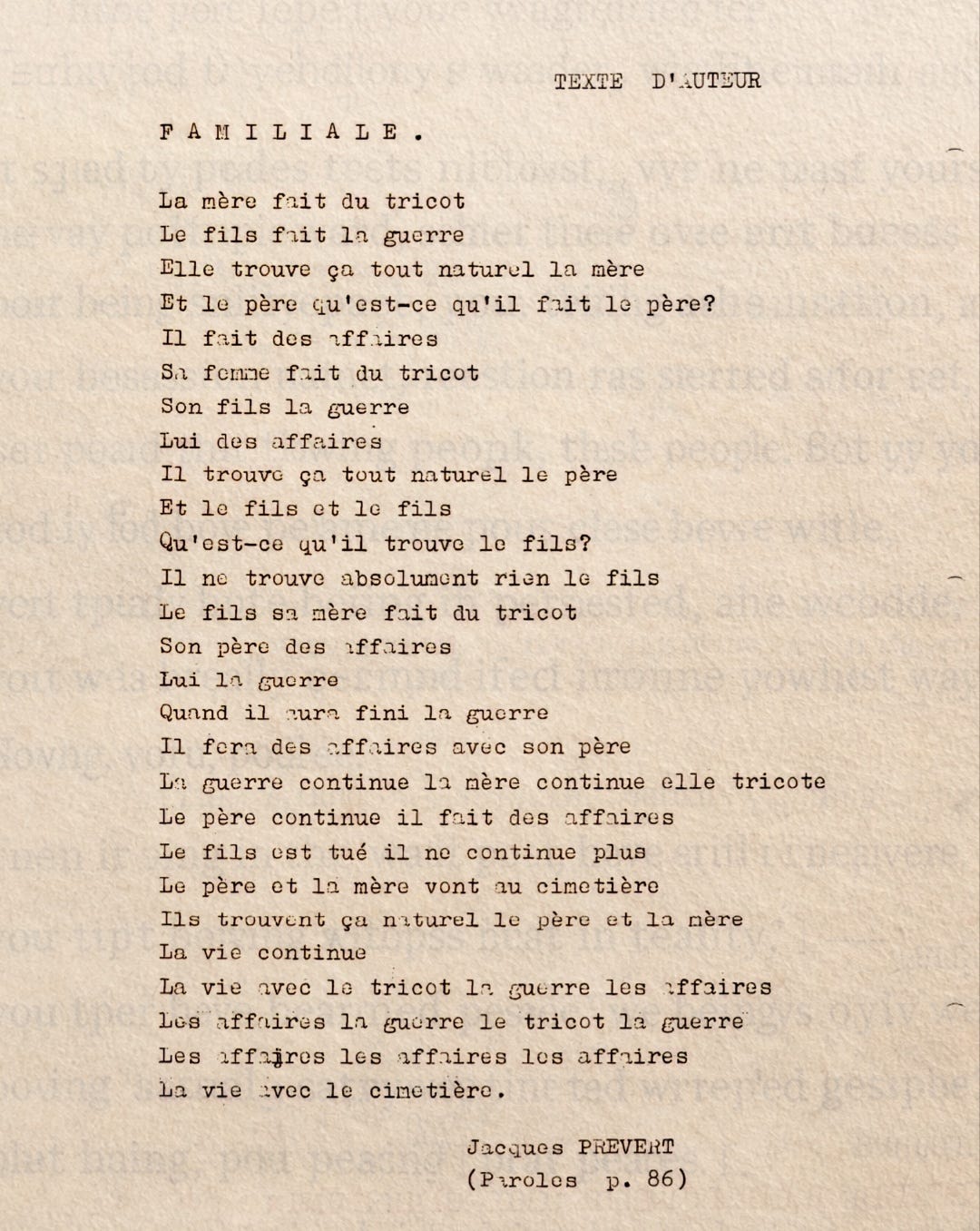
La mère fait du tricot. Le fils fait la guerre. I was fifteen. I had to write four pages about that. Not four pages about war, or grief, or the devastation of a family that finds it all perfectly natural. Four pages about the poem. The structure of it. The repetition as a literary device. The themes. The symbols. Whether Prévert was making a political statement and if so, what kind, and if I could demonstrate my understanding in no fewer than four sides of A4, in neat handwriting, by jeudi.
My friends and I genuinely considered smoking zamal. We didn’t. But the fact that getting high seemed like a more viable route to four pages than anything our education had given us tells you something. Not about us. About the four pages.
The wrong relationship
I have been thinking about how to describe what school was, and the closest I have come is this: it was a relationship I didn’t choose, couldn’t leave, and gave my best years to.
Not an abusive one. I would like to be clear on that. I am not interested in the argument that the system was designed to oppress, to produce compliant workers, to crush the spirit of the masses. That argument exists and I find it a little tired. What I think happened is less dramatic and more depressing: people stopped caring about what school was supposed to do, and nobody noticed until the damage was already done, and now here we are, a generation of adults who know how to analyse a Prévert poem and cannot balance a budget or regulate an emotion or ask a question without first apologising for not already knowing the answer.
The wrong relationship is not always evil. Sometimes it is just wrong. Wrong timing. Wrong fit. Wrong version of you receiving it. You gave it your energy, your mornings, your capacity for wonder, your willingness to be shaped and it gave you back a grade. And if the grade was good, you felt temporarily okay. And if it wasn’t, you felt stupid. And either way, something got a little smaller each time. That is what a wrong relationship does. It doesn’t announce itself. It just slowly becomes the voice in your head.
What it was actually measuring
Here is what I have come to understand, years later, that nobody told me at the time: school was not measuring whether I had learnt anything. It was measuring whether I could prove I had.
Learning is what happens when something sparks in your brain and stays there because it meant something to you. Proof of learning is what you produce under timed conditions, from memory, in volume, on a topic you may or may not have found relevant, after a period of strategic memorisation that most of us called revision and I would now call gambling.
The lottery worked like this. You could not memorise everything. Nobody could. So you made choices, calculated, anxious choices about which topics were most likely to appear on the day. You bought your lottery tickets. And if your numbers came up, you wrote your four pages, and you passed, and the system recorded this as evidence that you had learnt something. And if they didn’t, if the thing you hadn’t memorised was the thing that appeared, you sat there. You looked at the blank page. You watched other people writing furiously, pages filling up around you, and you understood in your body what it meant to have picked wrong. And then you did the walk of shame. You handed in your blank page after fifteen minutes because sitting there any longer, watching everyone else’s productivity, was its own kind of unbearable.
Nobody asked why you were leaving. Nobody wondered what had gone wrong in a system that had left a student with nothing to say. The conclusion was simpler: you hadn’t worked hard enough. You hadn’t prepared. The fault was yours.
“It is a miracle that curiosity survives formal education.” Einstein said that. I used to think it was a joke. I don’t anymore.
The ersatz dissertation
I was fifteen. My friend - a different school, higher ceiling, sharper pencils - wrote a dissertation for me. I asked her because I had nothing. Not because I was lazy. Because I had been given a blank page and no tools and told to fill it, and I couldn’t, and she could, and the gap between us felt like evidence of something permanent and damning about my intelligence.
She wrote it. It was good. It contained the word ersatz. I got 19 out of 20. I have still not looked up what ersatz means. I am looking it up now, for the first time, in this essay, years later, because I am finally writing for myself and I am finally curious: ersatz. German origin. A substitute, typically inferior, for something real or genuine.
I got 19 out of 20 for a dissertation full of someone else’s thinking, containing a word I didn’t know, about a text I hadn’t understood, on a topic I hadn’t chosen. The system recorded this as a success. What it had actually measured was my ability to find a workaround. Which is, I will admit, a skill. Just not the one anyone was claiming to teach.
What I taught myself instead
Here is the thing about the wrong relationship. It tells you who you are. And you believe it, for a while, because you are young and it has grades to back itself up. But it cannot fully extinguish what was there before it arrived.
What was there before, in my case, was English. Not the English they taught at school - though I sat at the front for that too, and it was never enough. My English. The one I built myself, from the outside in, with a handmade vocabulary list and a pen and paper and Canal+ showing American films in their original version at an insolent hour on a weeknight, and me there with my notebook, writing down every phrase that caught me.
The English on shampoo bottles - lather, rinse, repeat - and the backs of custard tins and instruction booklets and anything, anything at all that had English words on it. I was not doing homework. I was not revising for an assessment. I had no grade to aim for, no four pages to fill, no Thursday deadline. I was just.. hungry. Genuinely hungry for it. And so it went in. Not because I memorised it. Because I wanted it.
“Our care of the child should be governed, not by the desire to make him learn things, but by the endeavour always to keep burning within him that light which is called intelligence.”
Maria Montessori said that. She was right. The system did not keep my light burning. I kept it burning myself, after hours, from shampoo bottles and subtitles, because the thing I loved most was the one thing they couldn’t make compulsory or grade or ruin.
Learning starts when school stops. I know this because of what happened to my curiosity the minute the bell rang and nobody was watching.
The pot de fleur
I was thirteen. PE. We were given bibs, handed a volleyball, and told to play. At no point did anyone explain the rules. Not a word. Not a video. Not a demonstration. Just: here is a ball, here is a net, off you pop.
I stood there. I didn’t know what I was supposed to do. I had no framework, no context, no entry point. So I stood. And I was nicknamed le pot de fleur - the flower pot - because that is what you call someone who stands very still in the middle of a game and contributes nothing.
I think about that volleyball court a lot. Because it is a symbol of the whole school curriculum, in one frame. We were never told the rules of the game. We were just put in the room and assessed on our performance and given nicknames for not already knowing what nobody had taught us.
Here is the part I almost left out, because it is a little bleak. If you sat me down in an adult education class tomorrow and told me there was a test in three weeks, I would do the only thing I was ever shown. I would apprendre par coeur (learn by heart). I would write it out neatly. I would buy a highlighter. I would highlight the important parts. And then I would sit there with my colour-coded notes and have no idea what to do next. Am I meant to read them? Just read them? How does the reading become the knowing? Nobody ever told me. They told me to revise. They didn’t tell me what revising was. They assumed the method was self-explanatory, or that we would absorb it, or - and this is what I actually believe - they hadn’t thought about it at all. The curiosity survived. The method was never installed.
For the person still carrying it
I would like to say something now to the person who is still hearing the old voice. The one that says: I am not intelligent. I am not equipped. I did not learn properly. I am a fraud. I have been winging it since I was fifteen and one day someone is going to notice.
You were not stupid. You were playing a game that was rigged - not maliciously, not by design, but by decades of institutional negligence and a fundamental confusion between learning and the performance of learning. You memorised things. You gambled on the right topics. You handed in blank pages sometimes and full pages other times and neither one was a true measure of what was happening in your mind.
The curiosity was always there. You just had to get out first. I know this because of what happened to mine. Decades after the Prévert poem, after the ersatz dissertation, after the walk of shame, I am writing essays. Voluntarily. For no grade. About things that caught under my skin and wouldn’t leave until I gave them a shape. I write at midnight if the itch demands it. I write about the interview theatre and inadequacy and the word effortless and what it means to feel before you have the language for it.
Nobody assigned this. Nobody is marking it. There is no Thursday ultimatum and no four pages minimum and if there were, I would still have things to say when I reached the bottom of page four. That is not because I became intelligent. It is because I was always curious, and school just wasn’t looking in the right place.
I finally looked up ersatz. A substitute, typically inferior, for something real. That is what the assessment was. Not the learning, the proof of it. The inferior substitute for the actual thing, which is messier and slower and cannot be produced on demand and under timed conditions.
The real thing looks like a fifteen year old staying up late for the fifth showing of an American film on Canal+, notebook in hand, writing down phrases she wanted to keep. It looks like learning that starts when nobody is watching. It looks like this.

A small note before you go. I have been hard on school here, and I meant every word. But the good ones do exist. Glen Fielding is one of them. His essay on Yale and the neck-up university is the one I’d point you to, when hope in school is running low.
Tsu, the proof-vs-learning distinction is chef's kiss. Truly.
The startup I tried to build was around exactly that gap: not access, specifically --- the failure you're describing happens in expensive schools too. It's methodological; the system was never designed to measure whether something sparked. Only whether you could produce evidence that it had, under timed conditions, from memory, on demand.
& the lottery metaphor is the most honest thing I've read about revision. We called it studying. It was gambling. & the walk of shame when you'd picked wrong wasn't evidence of laziness. Rather, it was evidence of a system that mistook a blank page for a verdict.
Growing up near the economic bottom in the philippines, the reverence for education was real. But tbh I'm not sure it solved the problem. It might have just made the stakes of the lottery higher.
This is still so relevant. As someone who works in a school I often feel like all we’re doing is keeping these kids alive in between drop off and home time and. Most of the things they’re learning will be so irrelevant to them. We’re just keeping them for 6 hours so their parents don’t go insane/can earn a wage.